Showing posts with label urban fantasy. Show all posts

Monday, May 25, 2015

THOUGHTS on Thea Harrison's "Midnight's Kiss"

Thea Harrison's "Elder Races" series is one of my favourites - the heroines and heroes are diverse personalities, and the world-building is interesting. Unfortunately, I didn't enjoy the latest book, "Midnight's Kiss" nearly as much as some of the other books in the series. The heroine of "Midnight's Kiss" is Melisande (Melly), actress and heir to the Southern Californian Light Fae Demesne. The hero is Julian, the King of the Nightkind/Vampyres. Many years ago Melly and Julian were in a relationship, but the relationship ended badly, with both parties nursing unresolved emotional issues. The culmination of the previous book, "Night's Honor," however, yields consequences that throw Julian and Melisande back together; Justine, the villain (of this and the previous book), kidnaps Melisande in an attempt to manipulate Julian and take control of the Nightkind Demesne. "Midnight's Kiss" is about Julian and Melisande reacting to and surviving Justine's machinations, while dealing with their emotional issues.

In this post, I evaluate whether "Midnight's Kiss" passes three well-known tests for female presence in media: the Bechdel Test, the Mako Mori Test, and the Sexy Lamp Test. In doing so, I attempt to determine whether my lack of enthusiasm can be attributed to the book's failure to pass some of these tests.

1.0 Melly and the Sexy Lamp Test

Melly passes the Sexy Lamp Test - when she and Julian are being held captive, it is her innovation and lock-picking that allows her to kill the vampire guarding her and Julian. These actions allow her and Julian to escape. Melly also procures that motorcycle that allows her and Julian to make it back to a safe place. Melly thus makes plans, implements them, and the results of her actions directly affect the plot of "Midnight's Kiss." A sexy lamp could have achieved none of these things. Unfortunately, this is the only one of the tests that "Midnight's Kiss" passes - it fails both the Mako Mori Test and the Bechdel Test.[1]

The Sexy Lamp Test: 


  Melly

2.0 Melly, Justine, and the Mako Mori Test

Although Melly has a life independent of the heroes, having her own career and role in the political landscape of the Elder Races universe, as far as I can tell, she does not have a narrative arc that is independent from Julian's (the main) narrative arc. All of the examples of Melly's agency mentioned above are actions that trigger plot movement in Julian's narrative arc - i.e., the quelling of the uprising by the murderous and rebellious vampyre Justine. The other narrative arc that can be attributed to Melly is her goal to resolve the mystery of what actually happened to cause her and Julian to break up many years ago. Again, this narrative arc is not independent of Julian's - Melly thus does not pass the Mako Mori test, given the criteria below:

Mako Mori Criteria
(i) has a female character ( Melly)(ii) who has her own narrative arc  and (iii) that narrative arc is not about supporting a man's narrative arc 

The failure of the Mako Mori test, I think, is a major reason why I found "Midnight's Kiss" somewhat unsatisfying. While I liked Melly, I didn't find her to be a particularly interesting heroine. This can be at least partially attributed to the fact that, in failing the Mako Mori test, Melly isn't as complex a character as I prefer.

As a note, I think that if any of the narrative of "Midnight's Kiss" had been following Justine, she plausibly could have passed the Mako Mori test - after all, she sets the entire plot in motion by aiming to assassinate Xavier in the previous book, and by kidnapping Melly in this book. Her actions thus provoke, as opposed to support, Julian's narrative arc. However, we don't get any narrative that follows Justine, or her point of view, so it is difficult to attribute a "narrative arc" to her.

Mako Mori:
Melly:
Justine:  

3.0 "Midnight's Kiss" and the Bechdel Test

"Midnight's Kiss" just barely passes the Bechdel test. While Melly has conversations with other female characters - such as her mother, and twin sister - the content of these conversations, is for the most part, about men. The longest conversation that Melly has with another woman is the one with her mother, Tatiana. They discuss how Melly's mother figured out how to contact her, but this leads almost directly into a discussion about Keenan O'Sullivan, the biker who Melly bought a motorcycle from. Although Keenan O'Sullivan is not a main character, he is, technically, a man. Then Melly tells her mother about how Justine kidnapped her as a way to gain leverage over Julian. This part of conversation is thus also, in a way, about a man. Finally, however, the discussion turns to what sort of resources Tatiana can send to help Melly - i.e., cash, weaponed troops. This part of the conversation is not about a man, so "Midnight's Kiss" does pass the Bechdel Test, as it

(i) has at least two women in it, (ii) shows those women having a conversation, where (iii) the aforementioned conversation is about something other than a man.   

4.0 Other Issues

As I mentioned, I did not enjoy "Midnight's Kiss" as much as others in the series (like "Kinked,"  "Lord's Fall," Serpent's Kiss" and "Dragon Bound"). This was at least partially due to the fact that Melly failed the Mako Mori test, and consequently, I didn't find Melly to be a very interesting heroine. [2] The results of evaluating whether "Midnight's Kiss" pass the selected three tests for feminism are summarized below.

Mako Mori:
Melly:   

Sexy Lamp:
Melly: 

Bechdel:    

FOOTNOTES

[1] Although "Midnight's Kiss" only passes 1/3 of the selected tests for feminism, there are many, many, many books outside of the genre that fail all three of the tests.

[2] There were other little things that bothered me about the book. Such as the "You don't need a helmet, I won't let us crash" bit at the end. I understand that the main emotional issues that Julian and Melly have is trust, but I would have preferred that the resolution of their trust issues be exemplified in a way that seems...a little less irresponsible. Also, I didn't find the plot device used to break up Melly and Julian in the first place to be very original at all. But I did still enjoy reading the book! Thea Harrison is definitely an author that I trust and I auto-buy the books in the "Elder Races" series.

Monday, May 18, 2015

THOUGHTS on Meljean Brook's "Demon Bound"

Meljean Brook's "Guardian" series is one of my favourite UF (Urban Fantasy)/PNR (Paranormal Romance) series. The book that irrevocably hooked me on the series was book 4, "Demon Bound." In this post, I evaluate whether "Demon Bound" passes three well-known tests for female presence in media: the Bechdel Test, the Mako Mori Test, and the Sexy Lamp Test.

1.0 THE SET UP: Guardians, Demons, Free Choice and Bargains

Meljean Brook's Guardian series has very intricate and complicated world-building (I love it), that I will only briefly touch on.  The overarching theme throughout the series is the importance of human free choice. The main players in the series are Guardians, humans who have sacrificed their own lives in order to save people whose lives were in danger from preternatural threats like a demon, vampire or nosferatu. These humans who have sacrificed their lives are visited by the Doyen, Michael, who offers the humans a choice. They can choose to stand by their original choice and die, or they can choose to be transformed into a Guardian. If they choose to be a Guardian, they will gain supernatural powers of shape-shifting, super strength,  the ability to fly. They will also develop a unique gift whose nature is usually a reflection of some aspect of their human life.  Guardians are bound to protect humans from supernatural threats, but there is an important catch: they can never subvert a human's free will.

The heroine of "Demon Bound" is Alice Grey, a guardian whose gift has manifested as communication with and the control of monstrously large spiders. Known as the "Black Widow," even for a guardian, Alice is considered creepy and strange; her movements are sharp and jittery like a spider's, and her academic interests are obscure. Raised in Egypt in the late 1800s, Alice has already been a guardian for 120 years by the time that "Demon Bound" takes place. The hero of "Demon Bound," in contrast, is Jake Hawkins, a novice guardian who died protecting small children from a nosferatu that was terrorizing a village in Vietnam. Jake was introduced in the previous book, "Demon Night," where we learned that his gift is teleportation.

2.0 ALICE GREY and the MAKO  MORI Test

"Demon Bound" passes the Mako Mori test - the main narrative arc of "Demon Bound" is Alice Grey's story. Before Alice was transformed into a guardian, she made a bargain with a demon. She promised to bring the demon's Michael's heart, not knowing at the time who Michael was. After being transformed by Michael into a Guardian, and learning who Michael is, Alice is horrified by what she promised. Because the makers of unfulfilled promises are punished by 1000 years of torture in a frozen field in hell, Alice is conflicted between her loyalty to the Guardians and Michael, and the promise she made as a human. The resolution of this conflict is the main narrative arc of "Demon Bound"; it is the narrative arc that connects "Demon Bound" to overarching storyline of the Guardian series. [1] Alice thus has her own narrative arc that is not about supporting a man's narrative arc - she makes "Demon Bound" pass the Mako Mori test, as it

(i) has a female character ( Alice Grey)(ii) who has her own narrative arc 
 fulfilling her bargain without betraying the Guardians), and (iii) that narrative arc is not about supporting a man's narrative arc 

Mako Mori Test: 3/3 


3.0 DEMON BOUND and the BECHDEL TEST

"Demon Bound" also passes the Bechdel Test. Alice and Irena, another Guardian, have a four-page conversation about Baba Yaga. This segues into a discussion about Alice's bargain and the promise that Alice extracted from Irena years ago: in the event that the demon, Teqon, comes calling for the fulfillment of Irena's promise, Alice forced Irena to promise that she would lock Alice in a prison, so that Alice would not be able to fulfil her promise. Alice and Irena, two women, thus have a rather long conversation about something other than a man - so "Demon Bound"
(i) has at least two women in it, (ii) shows those women having a conversation, where (iii) the aforementioned conversation is about something other than a man. 

Bechdel Test: 3/3 

4.0 ALICE GREY, JAKE HAWKINS and the SEXY LAMP TEST

Alice Grey also passes the Sexy Lamp test. Much of the plot development in "Demon Bound" is low-action - Alice and Jake do a lot of research, given Alice's role as the Guardian's librarian, and Jake being assigned to be her assistant. The research, however, leads Alice and Jake to discover the skeleton of Zakril, one of the first Guardians. Research on Zakril's skeleton leads to Alice and Jake discovering the existence of the Grigori, one of the most important points in the overarching storyline. But it is Alice's actions/research that first leads to the discovery of the temple where Zakril is found, she thus could not be replaced by a Sexy Lamp (or in the case of Alice, a creepy lamp).

Additionally, when Alice and Jake are in Hell, held captive by demons, Alice is the one who figures out how to secretly communicate. And she is the one who rigs their prison with razor-sharp spider threads, a crucial ingredient in their plan for escape. The plan itself is Jake's, which shows that both Alice and Jake pass the Sexy Lamp test - neither of them could be replaced with a Sexy Lamp, because both take actions that are crucial to the events that occur - in this case, their escape from captivity. The issue of whether or not Jake passes the Sexy Lamp test is important for "Demon Bound" because Jake is much younger and in a lower position of authority than Alice within the Guardian ranks - i.e., he is in a role that is usually allocated to the heroines in romance novels. But in any case, both Alice and Jake pass the Sexy Lamp test.

The Sexy Lamp Test:   2/2
  Alice Grey
  Jake Hawkins
5.0 Jake Hawkins and the Mako Mori Test

Given that Jake fulfils a role that is usually allocated to heroines in romance novels, it's equally important to consider whether he would pass (a modified version of) the Mako Mori test. Does he have is own narrative arc that is not about supporting Alice's narrative arc?

Jake as a hero is a rather well-adjusted and uncomplicated guy, even if he has a problem filtering out insensitive things he shouldn't say - he's definitely not your typical broody alpha male with father issues. He does have his own narrative arc, however, even if it's small. Jake has always felt guilty about dying when he did, and leaving his then-pregnant girlfriend alone. He felt extra guilty because when he left to join the army, knowing he might die, he knew that he wanted different things than his girlfriend did, and feels that in dying, he didn't live up to his responsibility. Jake's pregnant girlfriend is a married great-grandmother by the time of "Demon Bound," as Guardians are bound to 100 years of training in Caelum before they are allowed to return to earth. Jake's narrative arc is thus about dealing with his guilt regarding what might have been his life. Although Jake's first contact with his human family is a teleportation accident, afterwards he chooses to face his daughter and see what he missed. He thus has his own narrative arc, separate from Alice's narrative arc, in which he shows agency in its resolution. All in all, Jake passes the Mako Mori test (modified to account for the fact that he's not female, he's just in the role normally allocated to female characters). So all in all, "Demon Bound" passes all three of my selected tests for feminism.

Mako Mori:
Alice:    
Jake:  N/A, , 
Sexy Lamp:
Alice: 
Jake: 

Bechdel: 
Alice:    
Jake:  N/A

6.0 Conclusion

"Demon Bound" is one of my favourites in Meljean Brook's Guardian series - the interactions between Jake and Alice are definitely funny, and there are definitely gritty parts (Alice is in a hard position), and grand parts (the way that Jake and Alice plan to deal with the demons and the bargain). The sad parts are downplayed, but there are sad parts (Alice's married life, for instance, and her students all deciding to ascend instead of staying to fight). It's thus not surprising as to why I feel justified in loving this book - not only does it fulfill all of my selected criteria for female presence, it also fulfils all my criteria for what I love in a book. It also does it while being original - very few romance novels have heroes like Jake, and even fewer books have heroines like Alice.

FOOTNOTES

 [1] I guess one could argue that the overarching storyline of the entire series is Michael's narrative arc, so every other narrative arc supports his. But Michael does not feel at all like a main character in any of the books except the final one, so I reject this analysis!

Tuesday, January 1, 2013

THOUGHTS on Steel's Edge (Book 4/4, Edge Series by Ilona Andrews)

Steel's Edge (The Edge, #4)Steel's Edge by Ilona Andrews
My rating: 4 of 5 stars

Steel's Edge is the fourth and final installment in Ilona Andrews' "Edge" series, and it's my second favourite of the series, after Bayou Moon (the second book). Although I liked the grittiness and twists of the plot in "Steel's Edge" better than the plot in "Bayou Moon," the romance and character development worked for me better in "Bayou's Moon." And since I've always read the "Edge" books with the expectations for a fantasy/romance, as opposed to an urban fantasy (like their excellent Kate Daniels Series), there were some issues with the romance and character development that I'd let slide for an urban fantasy, but couldn't quite get around for "Steel's Edge." But even with these issues, overall, I found "Steel's Edge" to be well-written and highly entertaining - I really liked it!

One of the reasons that I love books by Ilona Andrews is that they nearly always hit all four of my "funny, sad, gritty and grand criteria" for what makes a good book - i.e., there are always parts that are funny, parts that are sad, parts that are gritty and parts that are grand. As for the "funny," there are always funny parts in an Ilona Andrews book - I love what Jason, the crimelord of Kelena, offers Richard when he mistakenly thinks Richard has married Charlotte and that they'd bought a dog together, and I laughed out loud at the part where/how Jack informs Sophie and Charlotte that he is "adored" by his adoptive grandmother. And the "gritty" part is definitely achieved in "Steel's Edge." The hero, Richard Mar, is a vigilante whose aim seems to be to single-handedly wipe out the the illegal slave trafficking that operates in the Edge. And the heroine, Charlotte de Ney, is a healer who has grown disillusioned with parts of humanity that she begins using her healing gift to kill (albeit she is killing slavers). Any book whose main characters deal with slavery, human trafficking and disease is going to be fairly dark and gritty.Also, like the previous "Edge" books, there are gruesome maimings/deaths that are omfg!shocking (a good thing, imo), especially given romance-genre expectations. SPOILER
And the gruesome maimings/deaths are not not just of redshirts, but of characters who the reader has become attached to. **END SPOILER**
And these gritty events are interspersed with enough spectacular/grandiose parts - i.e., Richard doing some brilliant swordplay, or Charlotte implementing some impressive healing/antihealing, to satisfy my need for"grand" bits. And these gritty events are interspersed with enough spectacular/grandiose parts - i.e., Richard doing some brilliant swordplay, or Charlotte implementing some impressive healing/antihealing, to satisfy my need for "grand" bits.

There are also sad parts in the book. However, the most heart-wrenchingly emotional parts SPOILER
(i.e., Eleanore's death and the major plot twist regarding the captain of the slaving ship, omfg that part was amazing **END SPOILER**)
aren't associated with the hero/heroine, but with Jack and George, who the reader has been introduced to in the first Edge book "On The Edge." Now, like everyone else who reads this series, I've completely fallen in love with Jack and George, so these parts of "Steel's Edge" really tugged on my emotional heartstrings and even made me cry. But after reading these parts, I was left wondering whether I'd been tricked by some sort of sleight-of-hand. This is because when I'm reading a romance, I have the genre expectation (whether justified or not) that the deepest emotional arc should belong to the hero and/or heroine. And although there is a parallel drawn between George and Jack's situation on the one hand, and Richard and Kaldar's situation on the other hand, I didn't find this parallel developed much beyond a single mention. So in the end, while I was definitely getting the emotional highs and lows I want from a good book, I felt as if Jack and George's high-lows were given to reader in lieu of character development for Charlotte and Richard. And so I wasn't quite sure whether in the end, I really got to know Richard and Charlotte.

This in turn affected how well the romance worked for me. Although I could understand why Charlotte falls in love with Richard, I didn't quite buy how Richard falls in love with Charlotte (although I liked her well enough). I know that one reason Richard wants Charlotte is his conviction that Charlotte would "never become jaded or lose her resolve." He comes to this belief when he observes that she doesn't let go of her revulsion at injustice, even after all of the terrible things she (and Richard) sees in the slaver city. And although I do think Ilona Andrews did an excellent job coming up with travesties that would jade (or scar) most people, I didn't quite buy that Richard would take Charlotte's failure to become jaded after this experience as evidence evidence that Charlotte would NEVER become jaded or lose her resolve. This is because Richard himself is an example of someone who has been seeing these sorts of horrors for years, and doesn't seem to be someone who became (or considered himself) jaded after his first exposure to them.

There are also parts of the romance that I liked very much, however. In particular, I liked how most of Richard and Charlotte's interactions were so unfailingly cool and polite, despite the harrowing circumstances of their situations. While an average person would throw manners out the window in these sorts of circumstances, this is not so for Richard and Charlotte. Knowledge of, and adherence to the proper behaviour of nobility is where Richard and Charlotte excel, and their maintenance of courtly politeness to each other, even among plague, death and disfiguring, as well as Richard's dry attempts at levity in rather grave situations, really captured the "regency" part of the "regency in jeans" description that Ilona Andrews used to describe "Steel's Edge" on their author blog. Although I've read some reviews that disliked this aspect of their romance (I think they saw Richard and Charlotte's adherence to proper behaviour as relationship as indicative of a cold and passionless relationship), I read Richard and Charlotte's determination to maintain manners and proper behaviour in these crazy circumstances as a subtle competition between the two of them, and believable as the sort of interaction two people like Richard and Charlotte would engage in.

Now that I've more carefully thought about exactly why I had some issues with "Steel's Edge," it seems like the issues mostly arise becaues I have specific subgenre expectations, where "Steel's Edge" doesn't really fit into the relevant subgenre. Or actually even into any standard fantasy subgenre. So I don't think that going back and rereading "Steel's Edge" with UF, as opposed to romance, expectations would make me enjoy it more. For example, even if I considered the dismantling of the slavery-ring to be the main point of the book, and considered Richard and Charlotte's romance to be a side-plot (of which I have much less stringent expectations as compared to a main romance), I think I would still have issues with the fact that the main emotional arc of the story is associated with the side-characters, Jack and George, as opposed to the main characters, Richard and Charlotte. But maybe if I went into the book with only fantasy-genre expectations, and considered Jack, George, Richard, and Charlotte (and maybe Eleanore and Sophie) to all be "main characters" or the "main ensemble cast" or something, sort of like how I read the "A Song of Ice and Fire" series, "Steel's Edge" would work better for me. Although I'm not quite sure about this either! One thing that I love about Ilona Andrews books is their world-building (I already loved the aspects of the world built up from the previous books in the Edge series, and "Steel's Edge" gave me more of what I loved - I loved the description of the city, Kelena, in particular.) But one thing that throws me off-balance with the world-building in the Edge series is the way that the authors break standard fantasy genre conventions.

SPOILER

For instance, in "Bayou Moon," Cerise and William break the "You can't bring a dead person back to life" Rule.

And "Steel's Edge" seems to me to break the "When a character uses their powers for evil, what ensues is a long and bitter struggle between that character and temptations from the dark side" Rule for Charlotte.
**END SPOILER**


And although I sort of like it when genre conventions of this sort are broken, I usually want there to be a reason WHY they're broken, or to see repercussions of this rule-breaking throughout the rest of the world-system. And I'm not sure (on my first read through the series) if these reason or repercussions were made clear to me as a reader.

View all my reviews

Tuesday, December 11, 2012

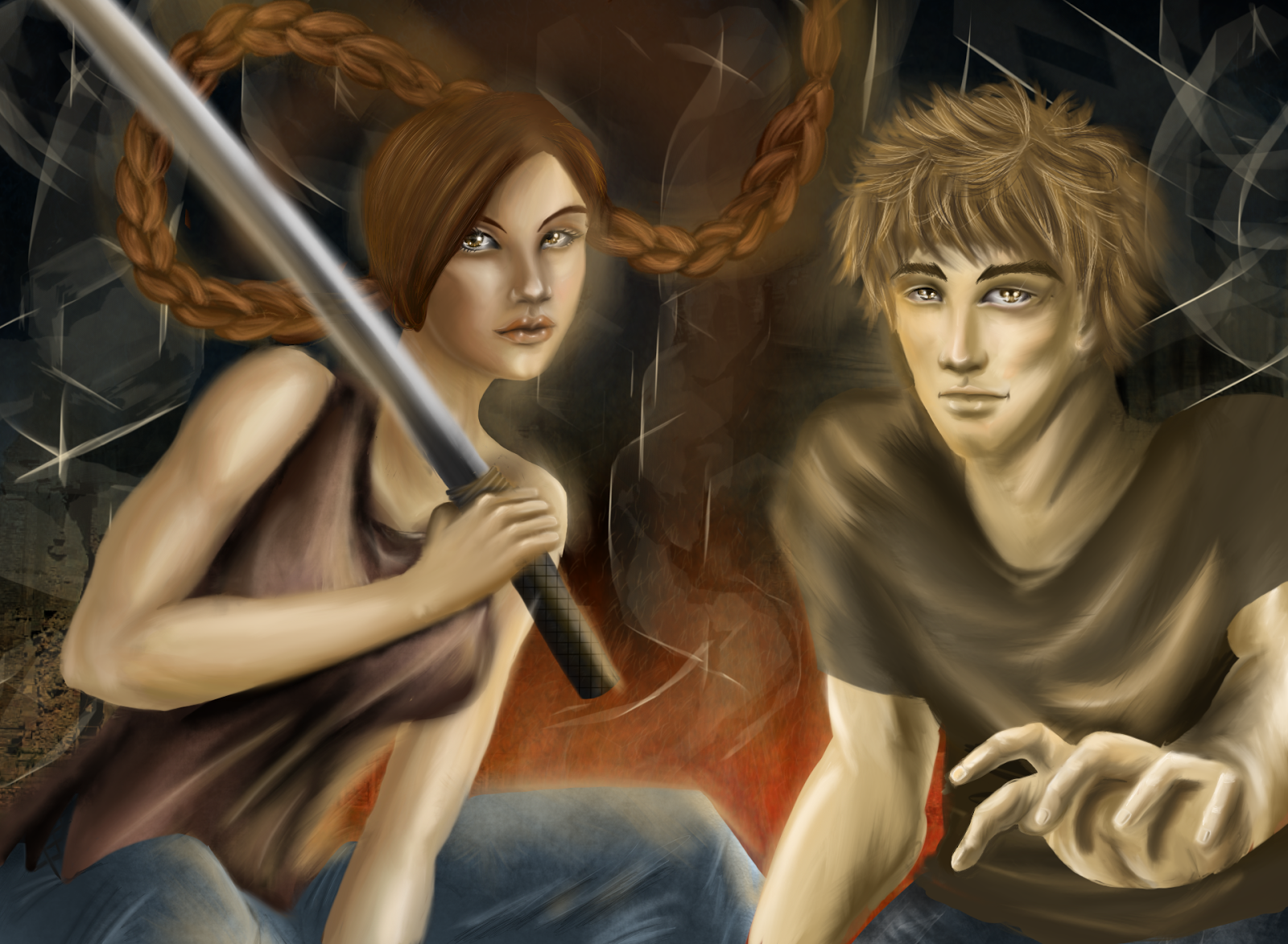
Tribute to Ilona Andrews' "Magic Bites


Kate and original her original "faithful canine companion" Derek Gaunt, circa "Magic Bites" from Ilona Andrews' "Kate Daniels" series. Painted while listening to (i) "Squire" by Tamora Pierce and(ii)  parts of "The Last Kingdom" by Bernard Cornwell. Derek was painted over my initial attempt (i.e., miserable failure) at painting Curran. Also, I copped out on background painting, imposing a picture of Raglan Castle from here ([link], Photograph Copyright © 2006 by Jeffrey L. Thomas) over my initial painted background. Not sure you can see it much - depends on how black the blacks on your screen are, I think.

Tuesday, November 6, 2012

THOUGHTS on "Lord's Fall" by Thea Harrison

Lord's Fall (Elder Races, #5)Lord's Fall by Thea Harrison
My rating: 5 of 5 stars

Lord's Fall by Thea Harrison

Thea Harrison's "Elder Races" series is set in an alternative earth, where the Elves, Fae, Witches, Wyr (which are like shapeshifters), Vampires, and Demons (including things like Djinn) make up what are referred to as the "Elder Races." The Elder Races are divided into demesnes, categorized roughly as above, whose central governing powers are based in (alternative versions) of urban centres such as New York (for the Wyr), Charleston (for the Elves), Houston (for the Demons) and San Francisco (for Vampires). The series kicks off with "Dragon Bound," in which Pia, our heroine, who just wants to keep her her head down and out of trouble, is blackmailed by her ex into stealing something from the Great Beast, Dragos Cuelebre, leader of all Wyr Kind. By the end of the book, Pia is thrust into an extremely high-profile position, being mated to the high-profile Dragos, with the worry that too many people will figure out her dangerous secrets. The ensuing books in the series focus on other high-level players in the world of the Elder Races.


"Lord's Fall" is the fifth book in Thea Harrison's "Elder Races" series, and it is a return to Pia and Dragos. I loved this book. It's tightly-written, the stakes are high, there are scenes of glory and tragedy, and there's lots of humour sprinkled throughout the book[1]. The external conflict is believably driven by the world-building and events from previous books, and the progress of internal conflict in the book is believable as well. The character's actions are understandable given their personalities and circumstances.

I'll talk about the external conflict first. The premise for the plot of "Lord's Fall" is two-fold: (i) Pia is headed to Charleston as a diplomatic envoy to the Elves, and (ii) Dragos is forced to stay in New York for the 'Sentinel Games', an event he is holding in order to find replacements for members of his sentinels. The wonderful thing about these premises is that they aren't random or stipulatory plot devices introduced solely to separate Pia and Dragos; they are the natural consequences of events introduced in previous books. In the first book, "Dragon Bound," Dragos breaks a treaty with the Elves when he crosses over Demesne borders in order to track down Pia; this is why Pia is on an diplomatic envoy. Book 2 "Storm's Heart" and Book 3 "Serpent's Kiss" each have as their hero, one of Dragos' sentinals. Both books result in the hero becoming mated to an individual with political affiliations that exclude the possibility of the hero remaining a sentinal, hence the necessity of the Sentinal Games. And finally, these plot premises compel the action towards a climax that ties in neatly with events from "Oracle's Moon" (Book 4).

As for the internal conflict and character development, I really loved how this was done. In PNR it's very often the case that the obstacles standing between the hero and heroine are due to stupid misunderstandings and murkily motivated actions on the character's parts. This is not at all the case in "Lord's Fall." The complexities in Pia and Dragos' relationships are completely understandable. Pia is 25 year-old half-Wyr who has just come into her power, Dragos is millenia of years old, has wielded influence over whatever he's wanted to for centuries, and has only had to pretend to be civilized when he wanted to. There's a huge power differential between them, and their mating has forced them into a position where they should be partners on an equal footing. Figuring out how they are going to interact as mates is not a trivial issue. One of the things I loved about this book is how Dragos and Pia are reasonable adults in how they approach these complexities. Although neither of them are pushovers regarding what they need from their relationship, they are honest with each other (and themselves) about why they take the actions they do.

This book made me like Dragos more than I did in book 1. In Book 1, Dragos was sometimes described as being clever, but I wasn't quite sure I believed it - he seemed like a rather standard PNR alpha male, whose brain reverts to a caveman mentality when it comes to interacting with their mate. But the way he was portrayed in "Lord's Fall" made me believe that he was clever. Now that he's mated to Pia and can't avoid the complexities associated with their emotional relationship, he shows that he's perceptive and clear-thinking when it comes to assessing their problems; he reflects on his actions when Pia disagrees with him, and independently comes to the conclusion that indulgence and tolerance are forms of autocracy, and that if he really wants their relationship to work, he needs to find a way to truly compromise. This book also made me like Pia more than I did in book 1. I like how she's tough, unwilling to back down when Dragos is domineering, and I also like how she's not stupidly stubborn about pushing at his domineering ways on principle; she can assess when pushing her case would worsen the situation and acts accordingly. I've also come around to appreciating how Pia is unashamed of (i) being somewhat girly (painting her toenails, and putting on makeup) and (i) being a non-predatory wyr surrounded by extremely powerful predatory wyr.


Final verdict? As you can probably tell, I loved it. My criteria for what I satisfies me in a book is that it should be funny, sad, gritty and grand (taking a quote form Vivian Vande Velde). This book definitely hits three of these criteria - it's funny, gritty and grand. There were also parts where the events that occur are objectively sad, but I didn't even mind that these didn't tug on my heartstrings. This is because I'm fairly certain they weren't supposed to, seeing as they were told from Dragos' rather callous/calculating point of view. "Lord's Fall" book wasn't completely perfect for my reading tastes though - for instance, didn't find Eva, introduced as a major secondary character, to be a very interesting character. Yet. And although the writing style is tight (in that there were no parts where I wondered "What is the point of this passage?"), I could only make this judgement after I re-accustomed myself to the liberal pop culture references[2].


-----Foot Notes------

[1] Although nothing as good as the "Snakes on a Plane" reference in "Serpent's Kiss." That was amazing.

[2] The reference to pop-culture bothered me when I first started reading the series. I still don't quite see the point of mentioning that their smartphones are iphones, or letting me know exactly which Tupac song is playing in the car. (Unless this is a hilarious reference to a terrible Samuel L. Jackson movie.) But everything else in the book is so good that I can ignore the pop-culture references after a while. Unlike the pop-culture references in J. R. Ward's BDB series, which annoy me to distraction.


View all my reviews

THOUGHTS on "Archangel's Storm" by Nalini Singh

Archangel's Storm (Guild Hunter, #5)Archangel's Storm by Nalini Singh
My rating: 4 of 5 stars

Although I enjoyed "Archangel's Storm" very much, I didn't feel entirely satisfied afterwards. Gorgeous prose, solid world-development, and a tightly woven plot, but I was left wanting more, in terms of the relationship between Jason and Mahiya, and in terms of the development of the series' overarching plot. Although I know that the relationship between Jason and Mahiya wasn't supposed to be the tumultuous love-across-centuries angst-fest that was Dimitri and Honor in the previous book in the series, and I can appreciate slow and quiet romances, I wanted the emotion to be a bit deeper than it was, and for the overall stakes to have gotten higher than they got. There were hints of change afoot, in terms of a change in the structure of the Cadre of Ten, but at the end, the questions I wanted answered were left unanswered.

In terms of the romance, the relationship between the hero and heroine depends largely, for me, on getting to know the characters, and through this, understanding why they are falling in love with each other. I think that because both Jason and Mahiya are such quiet, understated characters, it was little hard for me to see how they were falling in love.

For instance, although I liked Mahiya as a character, I didn't see any aspect to her character that was outstanding in a way that would make her different from other women, i.e., that would make her the woman that could break through Jason's emotional barricades. Mahiya is not emotionally weak - she has survived for decades in terrible circumstances, trapped by people much more powerful than her. But she didn't seem extraordinarily strong to me either. For instance, we can compare her with Ashaya Alleine, the heroine from Singh's fifth installment in her Psy-Changeling Series . Ashaya was similarly trapped in a bad position by people with much more power than she had. But I clearly remember getting to the part of HtP where Ashaya gives her first broadcast, exposing the Council's evil plans, and coolly lying about the Omega project so that the Council's plans will sink. I remember thinking that this heroine, who has no changeling claws, weak Psy physiology, and a completely unaggressive Psy specialty, nonetheless had holy-shit-balls-of-steel. I didn't find that moment like that with Mahiya. Although a moment like that isn't really necessary - after all, it's not as if women who don't have holy-shit-balls-of-steel don't deserve love - I just felt myself wanted more from her, some sort of uniqueness/extraordinariness, to understand why she was the one that Jason fell in love with.

As for Jason, although we learn a lot about his past, and can infer that he has vulnerabilities, Jason is so strong and quiet that we only ever see his tiny glimpses of his vulnerabilities. Even at the end of the book, his behaviour continued to mask outward expression of these vulnerabilities. This is why I also have a problem when I try to understand why Jason is the one that Mahiya falls in love with. When Mahiya notes that she has had experience with other men, but that Jason was the only one that had ever engendered such feelings in her - but I couldn't quite understand how she could fall in love with such a closed book. Objectively, I can understand that this portrayal of Jason is likely intentional - part of his core character is his strength and quiet, so that even close observers will only ever see a peek of vulnerability. But subjectively, I wanted to get to know Jason better, to better understand how his words and actions were a product of his extraordinary history and circumstances.

The third aspect of a romance, besides the hero and heroine, is, of course, the relationship between them, and how it grows. Although I liked what developed, and how it developed, but I wanted just a little bit more. Jason and Mahiya's relationship at the end of the book is a little unsure, not set in stone; there are a lot of issues about how their relationship will work that are left unresolved.

The same is true for the plot development. I wanted just a little bit more. The unexpected parallels in power between Neha and Nivitri are a fascinating plot twist, and the war between the two factions is high-stakes, but I missed the sense of a gradual build-up towards the plot climax. The result is that the plot climax seems somewhat backgrounded, and less urgent than other (more satisfying) plot climaxes. The consequences of Neha and Nivitri's power parallels is also left unanswered, which left me feeling somewhat unsatisfied. One thing to note, however, is that this is not a stand-alone book. It's book 5 of a Nalini Singh series, and a Nalini Singh series is not a set of loosely connected books, but a set of books that are tightly interwoven in an overarching storyline. This means that I'm storing this vague sense of disatisfaction in a temporary holding space in my mind, because I have faith that Ms. Singh will address all of these things in later books - not just the unresolved consequences with respect to the plot, but also the further development of Jason and Mahiya's relationship.


View all my reviews

Friday, June 3, 2011

THOUGHTS on: Jennifer Estep's "Web of Lies"

Title: "Web of Lies"
Author: Jennifer Estep
Series: Elemental Assassin 002
Genre: Urban Fantasy
Oh, I am very happy with where the second book of the Elemental Assassin series, “Web of Lies,” ended. So pleased that I sort of wish “Web of Lies” and “Spider's Bite” had been one book, because things that had bothered me about the first book no longer matter much given how things unfold in this second book, and “Web of Lies” ends on this note where it feels like we're on the brink of seeing what this series is all about. But first, the requisite blurb: Gin Blanco, retired assassin and new owner of the Pork Pit is starting to get bored with retirement. Things start rolling, however, when Violet Fox, a student at the local college, comes into the Pork Pit asking for help from “The Tin Man.” Although not immediately willing to acknowledge that “The Tin Man” was the codename for Fletcher Lane (Gin's former handler), Gin's curiosity is peaked when it becomes clear that someone is trying to kill Violet. Gin soon finds out that Tobias Dawson, one of the biggest mine operators in Ashland, has been trying to intimidate Violet and her grandfather Warren into selling him their land, and Tobias seems quite willing to kill Violet in order to get what he wants.
So, what did I like? First, the characters. As I mentioned previously, I like Gin as a heroine, because she keeps her cool, and isn't overly sassy[1]. Reading “Spider's Bite”, I felt that I didn't see quite enough vulnerability from Gin as I would have liked, but “Web of Lies” definitely has scenes where I empathized with her. For example, the short scene where Donovan pulls away from Gin's touch right after they had sex - I thought was beautifully done. Although it felt somewhat muted, and it was barely touched upon, it was clear to me as a reader that Gin was hurt. And I thought that the way she held back from immediately confronting Donovan about it was also testament to Gin's strength and patience.
As for Donovan Caine, well, he didn't annoy me as much in this book, because it became clear that he wasn't supposed to be the “hero” you get in a romance novel [2]. So instead of feeling generally dissatisfied with the relationship between Gin and Donovan, I began to see Gin's feelings for Donovan as a small window into Gin's psyche – i.e., a window into the things Gin wants in her life, and what she will and will not do to get them. And in this aspect, I thought the relationship was very successful. I learned that Gin is proud, but not overly proud. She was willing to make the first move twice, even following rejection, but she was not willing to chase after Donovan more than that. And when Owen Grayson (a wealthy businessman who I assume we will see more of in later books) was making his interest in Gin very clear, I thought Gin's general wariness and standoffishness towards him, despite her curiosity about Owen (and Donovan's continued rejections), showed how steady Gin was in terms of her feelings for Donovan. So although I still don't quite see why Gin is attracted to Donovan, I nonetheless was convinced of the strength of her feelings for him[3].
While we're on characters, we have a new one, Owen Grayson! I liked Owen quite a bit. But then again, I like the over-protective brother character-type, and Owen showed himself to be observant in the way that he recognized Gin in disguise, measured in the way he approaches his courtship of Gin, yet brave enough to take gambles that could endanger his own life (in how he left himself open when Gin was contemplating stabbing him). I'm looking forward to seeing him in book 3.
Second, I like how the stakes have also been raised in terms of the plot – Gin's magic has almost doubled[4], and things are starting to get more interesting. Gin has evolved from being someone who was just surviving, to a someone getting ready to confront the demons in her past, even if this means taking on Mab Munroe, the fire elemental who controls Ashland by killing and torturing anyone who gets in her way. I'm also really looking forward to how this plays out in book 3 : )
Prose: B+
Plot: B+
Characters: A
World-building: C+
X-factor: A (For the rushing "grand" factor I felt at the very end, when Gin was pithily laying out her goals)
------------------------------------------------------
[1] Despite what Owen says : P
[2] i.e., the long-term love interest, the one that sticks around for the HEA. Although I wouldn't mind a matured Donovan, with more of spine and more character, coming back in future books to make things interesting.
[3] I, personally, having much less emotional strength of mind than Gin, would have gone for Owen over Donovan like a shot ; )
[4] Although not in a deus ex machina way - given Gin's family, her increase in power was not inconsistent with what we might expect.

Sunday, May 29, 2011

THOUGHTS on: Jennifer Estep's "Spider's Bite"

Title: "Spider's Bite"

Author: Jennifer Estep

Series: Elemental Assassin 001

Genre: Urban Fantasy

(Review written May 29th, 2011)

I just finished reading "Spider's Bite," the first in the Elemental Assassin series by Jennifer Estep, and I enjoyed it. Gin Blanco is an assassin known as "the Spider." A last-minute job that seems like a quick way to make big bucks turns out to be a set-up, a ploy to frame Gin for killing corporate whistle-blower Gordon Giles after killing her. Gin is soon caught between trying to figure out who set her up, so she can kill them before they kill her, and along the way we meet Finnegan Lane, Gin's foster brother; the Devreaux sisters, a pair of dwarven sisters with interesting talent sets; and Donovan Caine, perhaps the only non-corrupt cop left in Ashland. Donovan's partner was hit by Gin before the events of “Spider's Bite”, and while Donovan Caine is willing to call a truce with Gin in order to find out who was behind the murder of Gordon Giles, he is not willing to forget that has sworn to bring to justice the assassin who killed his partner.

I thought "Spider's Bite" was a good, solid start to a series. Like an urban fantasy heroine should be, Gin Blanco is tough, capable and confident. And a little quirky, in that she is a bit of a foodie, and quite enjoys the classes she takes at the local college as her "cover" as a perpetual college student. As an assassin Gin is understandably morally off-centre, but she still holds fast to her own set of morals and honour, and is therefore admirable. Gin also comes off as vulnerable at times, usually when she struck by unbidden memories of people she cared for. These parts are (to me) quite brief, however. I like seeing a bit more vulnerability in my heroines, in order to better connect with them, but since this is only the start of the series, I suspect this may develop with further installments. And on further contemplation, I realize that the brevity of these parts does a good job of illustrating Gin's mental state. As an urban fantasy, "Spider's Bite" is written in first person, and so these moments of vulnerability are necessarily portrayed as short, because Gin, at this point in her life, will not let herself be vulnerable. Continuing along this line of thought, the book's portrayal of Gin's attraction to Donovan Caine might also be skewed by either conscious or unconscious editing on Gin's part: although she admits that Donovan's idealistic moral view is rare and admirable, her attraction is primarily portrayed as physical, with several descriptions of Donovan's physical attributes, and what Gin would like to do with, ahem, said attributes. A possible way of reading this, however, is that this asymmetry reflects not the compositional proportions of Gin's actual attraction to Donovan, but rather only what Gin will admit to. I suspect now that it may actually be Donovan's moral uprighteousness that primarily attracts her: here is an honourable man with a pure moral code that Gin, a bit unhappy and uneasy with the extreme boundaries of her own moral code, wishes she could, but could never actually adhere to. All in all, I liked Gin, and how she was portrayed. I especially appreciated that Gin wasn't a hotheaded, reckless heroine (although those heroine's have their places too).

Unfortunately I wasn't as pleased with the portrayal of Donovan Caine. Although we are told that Donovan has an upstanding moral code, and he certainly shows priggishness in adhering to his code, I never really found a part where this priggishness translated into an attractive quality. After all, honour is sexy, right? Or at least, it can be portrayed as such. For example, the moment in George R. R. Martin's “Game of Thrones” where Lord Eddard Stark claims the heartbreaking responsibility of executing his daughter's direwolf puppy? Or the moment in “To Kill a Mockingbird” when Atticus Finch asks “Do you really think so?” when facing the lynch mob (not to mention Jem's obstinacy to abandon his father)? Shivers[1]. Not that I require all heroes to have the moral fibre of Atticus Finch, but I never came across any scene like this with Donovan Caine. His moral uprighteousness was usually portrayed by him showing disappointment or outright disapproval towards Gin's actions and values. And so it was a bit difficult for me to like him, or understand why Gin found him attractive. Unless there really is just a physical attraction. In which case, sure Donovan Caine is described as physically appealing, seeing as I like dark hair and hazel eyes as much as the next girl, but then Gin becomes much less interesting. Also, while his loyalty in his partner is, I suppose, commendable, the academic in me abhors the fact that this is blind loyalty. His lack of research into his partner to see whether his loyalty is justified irks me. I certainly wouldn't go making vows on public television without making sure I had collected all the relevant information. Again, this is the first in the series, so although I didn't find Donovan particularly likeable in this installment, we shall see. Although since this is an urban fantasy, and not a romance, I suppose I shouldn't have the expectation that I ought to feel attracted to the heroine's love-interest (my criteria #2 for categorizing a romance as one that fulfils its duties to its readers,) and certainly not so early. The romance in urban fantasy series usually comes a bit later in the series.

Prose: B (Not bad, but I felt that Gin as narrator told us too much about how the world and magic in it worked in words, instead of showing us with observations)

Plot: C+ (No holy-shit moments, but I don't think "Spider's Bite" set out to thrill and astonish us with plot twists and turns, so I had no problem with this.)

Characters: B (Gin was interesting, and the side characters like Finn and the Devreaux sisters were quite interesting and amusing, but the main love interest, Donovan, fell flat for me)

World-building: C+ (fairly standard urban fantasy, cities with dwarves, giants and vampires, and so far a fairly standard magic system aligned in terms of elements)

X-factor: A (I enjoyed it)

-----------------------------------------

[1] Er, It occurs to me now that my love for Atticus Finch may not be the norm. Or is it? I don't recall other girls in my 1oth grade class sighing over Atticus...(or any of the characters in any book we were assigned to read.)


THOUGHTS on: Gena Showalter's "Awaken Me Darkly"

Title: "Awaken Me Darkly"
Author: Gena Showalter
Series: Alien Huntress 001
Genre: Urban Fantasy, Paranormal/Science-fiction Romance
(Review written April 19th, 2011)
I've just finished reading Gena Showalter's "Awaken Me Darkly." It feels more like urban fantasy than paranormal romance to me (which is too bad because I picked it up craving some paranormal romance), given that it's written in first-person, which is characteristic of urban fantasy. However there's more emphasis on romance (or at least, more paragraphs dedicated to the romance) than what I noticed in urban fantasy series that I have previously read, like Ilona Andrews' Kate Daniels series, and Carrie Vaughn's Kitty Norville series, etc.
Unfortunately, this novel doesn't work for me as either an urban romance or a paranormal romance. In short, I don't like it very much. As a warning, there are unmarked spoilers below, as I have used specific plot “twists” to illustrate some points.
First, I don't like the heroine, Mia Snow. A government-sanctioned alien hunter, Mia is pretty much a bigot when it comes to aliens. I almost stopped reading three pages in because she was so hateful. Although we are eventually given the reason for her racism, I still can't like her given that for the majority of the story, Mia never questions these prejudices, or acknowledges that circumstances in her history might have given her a skewed, less-than-rational view of aliens. This lack of doubt on her part suggests to me that she is either i) aware that she's a bigot, but too hateful to care, or ii) too stupid to realize that her views are bigoted. Not even when she finds out that she herself is half-alien do we see Mia spending much time questioning the validity of her (I assume by then, former) views. We don't see her feeling any guilt about having ruthlessly killed aliens, or any remorse for having bigoted views. Rather we see her being angry at her father for lying to her and “misleading” her into hating aliens. To me this indicates a serious inability or unwillingness to acknowledge her personal responsibility for her past actions/views.
This emotional immaturity is a facet of her character that I really dislike. While I'm sure Mia is supposed to be the typical "strong heroine" associated with urban fantasy, as she can kick physical ass, is ruthless as an alien hunter, and supposedly has an “indomitable will”, while reading I felt that Mia lacks mental/emotional strength. For example, when Mia first learns that she is half-alien, and that the murderer she was pursuing was her biological mother, we see Mia wanting to inwardly scream in defiance of the truth, and we also see several instances of her refusing to listen to the truth (eg. her screaming at Kyrin to shut up, cursing at him, slapping him, etc.). These repeated references of her unwillingness to face the truth[1] indicate an unjustified emotional immaturity. Now, Mia doesn't actually scream in defiance (usually), which I suppose might be meant to show that she has some sort of mental fortitude, but we're never shown her struggle with these issues. She just wants to scream at the unfairness of it all, but doesn't. So instead of seeing her as vulnerable, and overcoming her vulnerabilities through an admirable emotional strength, I got the sense that she was emotionally weak...and that her actions were completely disconnected from her emotions/internal state. In general, I thought that Mia screamed too much, either out loud, or silently. When a story is written from a first-person point of view, even though the screaming is silent, it's annoying.
As for her ruthlessness in hunting, which I expect was supposed to show her badassness, well...it troubled me greatly. In fact, it came off rather like power-tripping irresponsibility. Thus not only is Mia emotionally irresponsible regarding her own personal conduct, she is also irresponsible regarding the rights and personal welfare of others.
Exhibit A: The situation where Mia ordered all of the citizens, at what seemed to me like a peaceful protest, to be arrested.
Note that she herself had instigated the protest as a scheme to trap Kyrin, who also plays the role of her "love interest", for questioning in a serial murder case[2]. Mia never even tells her underlings on what grounds to arrest the citizens - and this is obviously because there are no grounds to arrest the citizens! It was just part of her ploy to make sure Kyrin did not escape her trap.
Ok, right. I'm sure this is an obvious point but: this completely tramples over the rights of the citizens that she is supposedly protecting! This, to me, shows that the heroine completely lacks a sense of responsibility towards the public she has supposedly sworn to defend. Her claims that she hunts aliens to protect humans is a lie. She hunts aliens because i) she's a bigot and therefore hates them, ii) she wants revenge because aliens killed her older brother, and iii) because she's trying to make her alien-hating father love her again. If Mia's ruthlessness actually stemmed from some honourable source, like wanting to protect the public, I may have been able to accept it (maybe...), but it doesn't. It stems from what I felt to be weaknesses in her character. For me, this would only be acceptable in a character if that character were the villain of a book, not the heroine.
Exhibit B: Mia's parroting of laws that are obviously ruthless and unjust - for example, any aliens involved with crime are to be eliminated/executed. They don't have to be guilty, they just have to be involved.
Now this is obviously a problematic law. If Mia were a child, I could understand how she could parrot these laws and not question them...but she isn't! Here I am in a similar situation as regards to her bigotry: I can't decide if this is an example of her ruthlessness - i.e., if she realizes these laws are wrong, but doesn't care, because it lets her kill more aliens, or if it's an example of stupidity, because she doesn't realize these laws are unjust. In either case, I care for Mia less and less.
For all of these reasons, I found it impossible to admire or like Mia. And thus I found it beyond annoying whenever I was told or shown that the majority of the characters in the book did admire and like her.
As for the hero, Kyrin? He could have been a computer for all I could tell. To me he seemed little more than a requisite plot device. Sure, he was described as powerful, beautiful, and given the requisite bad past to atone for. And I suppose the way he continually overrides Mia's free will with either i) physical binds (eg. tying her up) ii) a magical armband (which inflicts pain on her if she tries to escape his house), or iii) drugs, are indicative of the requisite domineering aspects we expect from an urban-fantasy alpha-hero[3]. But I never got a sense as to what his character was like. There is a part in the book where Mia describes what she has concluded about Kyrin's character, given the state of his home, but as we were told instead of shown these things, I didn't really buy it.
Needless to say, the romance didn't work at all for me. It was pretty much doomed since I didn't like either the hero or heroine, but even so, I didn't see them getting to know each other at all (I could refrain from making the actual joke about “know” in the biblical sense...) There was no sense in which I felt they complemented each other, or, actually enjoyed each others company.
So in short, this book didn't work for me as an urban fantasy, because what I look for in an urban fantasy is i) a strong heroine and ii) a good plot[4]. Nor did it work for me as a paranormal romance because what I look for in a romance is i) likeable heroines and heroes, and ii) scenes that show the hero and heroine are falling in love. I didn't find any of those in “Awaken me Darkly.”
Will I read another book by Gena Showalter? I think I would, if only because I think this is one of her earlier books. Perhaps she hadn't hit her stride yet. And I didn't read the book all that carefully - it may have been the case that the things above all jumped out at me, and I missed the significance of things that may have changed my mind about my assessment.
Prose: C (I wasn't too fond of the writing style - there was more telling than showing, I felt)
Plot: C (predictable, but not terrible)
Characters: F (...obviously, I did not like the characters)
World-building: C- (I wasn't very drawn in by the world, but I'm not big on aliens in the first place. And since this is the first in a series, maybe it gets fleshed out in later books.)
X-factor: n/a
-----------------------------------
[1] A truth, which really, she must have, or at least should have, suspected.
[2] When I say "a serial murder case," I should actually probably say "the serial murder case” since this murder case forms the backbone of the plot.
[3] Right, I haven't even voiced my opinion on how these actions by Kyrin are, to say the least, problematic. But that's because although now that I've listed them, I see objectively how problematic they are, but I didn't really care when they happened in the book. This is probably because I didn't (and still don't) buy Kyrin as an actual character, whom I might expect to have admirable characteristics.
[4] I haven't mentioned the plot above. Basically, I felt it was rather predictable. I saw it coming that i) she was half-alien, ii) Atlanna was her mother, and iii) that the brother Atlanna referred to would be Dare, and not Kane. But that may be because I've been reading quite a bit of Carol Berg recently, which has primed me to look out for plot twists. Although I must say, this is the first novel I've ever read where the heroine uses a poisoned whip to whip the villain to death.
...Also, there is a part where Mia tries to glean insight from an Atlantis myth, into the motivations of a suspect named Atlanna, purely because "Atlanna" sounds like "Atlantis". If that's representative of the type of police work that Mia uses to link suspects to crimes, the aforementioned laws are even more problematic than I thought.